Regression:linear model
这里用的是 Adagrad ,接下来的课程会再细讲,这里只是想显示 gradient descent 实作起来没有想像的那么简单,还有很多小技巧要注意
这里采用最简单的linear model:y_data=b+w*x_data
我们要用gradient descent把b和w找出来
当然这个问题有closed-form solution,这个b和w有更简单的方法可以找出来;那我们假装不知道这件事,我们练习用gradient descent把b和w找出来
数据准备:
xxxxxxxxxx# 假设x_data和y_data都有10笔,分别代表宝可梦进化前后的cp值x_data=[338.,333.,328.,207.,226.,25.,179.,60.,208.,606.]y_data=[640.,633.,619.,393.,428.,27.,193.,66.,226.,1591.]# 这里采用最简单的linear model:y_data=b+w*x_data# 我们要用gradient descent把b和w找出来计算梯度微分的函数getGrad()
xxxxxxxxxx# 计算梯度微分的函数getGrad()def getGrad(b,w): # initial b_grad and w_grad b_grad=0.0 w_grad=0.0 for i in range(10): b_grad+=(-2.0)*(y_data[i]-(b+w*x_data[i])) w_grad+=(-2.0*x_data[i])*(y_data[i]-(b+w*x_data[i])) return (b_grad,w_grad)1、自己写的版本
当两个微分值b_grad和w_grad都为0时,gradient descent停止,b和w的值就是我们要找的最终参数
x# 这是我自己写的版本,事实证明结果很糟糕。。。# y_data=b+w*x_data# 首先,这里没有用到高次项,仅是一个简单的linear model,因此不需要regularization版本的loss function# 我们只需要随机初始化一个b和w,然后用b_grad和w_grad记录下每一次iteration的微分值;不断循环更新b和w直至两个微分值b_grad和w_grad都为0,此时gradient descent停止,b和w的值就是我们要找的最终参数b=-120 # initial bw=-4 # initial wlr=0.00001 # learning rateb_grad=0.0w_grad=0.0(b_grad,w_grad)=getGrad(b,w)while(abs(b_grad)>0.00001 or abs(w_grad)>0.00001): #print("b: "+str(b)+"\t\t\t w: "+str(w)+"\n"+"b_grad: "+str(b_grad)+"\t\t\t w_grad: "+str(w_grad)+"\n") b-=lr*b_grad w-=lr*w_grad (b_grad,w_grad)=getGrad(b,w)print("the function will be y_data="+str(b)+"+"+str(w)+"*x_data")error=0.0for i in range(10): error+=abs(y_data[i]-(b+w*x_data[i]))average_error=error/10print("the average error is "+str(average_error))xxxxxxxxxxthe function will be y_data=-inf+nan*x_datathe average error is nan
上面的数据输出处于隐藏状态,点击即可显示
2、这里使用李宏毅老师的demo尝试
引入需要的库
xxxxxxxxxximport matplotlibimport matplotlib.pyplot as pltmatplotlib.use('Agg')%matplotlib inline import random as randomimport numpy as npimport csv准备好b、w、loss的图像数据
xxxxxxxxxx# 生成一组b和w的数据图,方便给gradient descent的过程做标记x = np.arange(-200,-100,1) # biasy = np.arange(-5,5,0.1) # weightZ = np.zeros((len(x),len(y))) # colorX,Y = np.meshgrid(x,y)for i in range(len(x)): for j in range(len(y)): b = x[i] w = y[j] # Z[j][i]存储的是loss Z[j][i] = 0 for n in range(len(x_data)): Z[j][i] = Z[j][i] + (y_data[n] - (b + w * x_data[n]))**2 Z[j][i] = Z[j][i]/len(x_data)规定迭代次数和learning rate,进行第一次尝试
距离最优解还有一段距离
xxxxxxxxxx# y_data = b + w * x_datab = -120 # initial bw = -4 # initial wlr = 0.0000001 # learning rateiteration = 100000 # 这里直接规定了迭代次数,而不是一直运行到b_grad和w_grad都为0(事实证明这样做不太可行)# store initial values for plotting,我们想要最终把数据描绘在图上,因此存储过程数据b_history = [b]w_history = [w]# iterationsfor i in range(iteration): # get new b_grad and w_grad b_grad,w_grad=getGrad(b,w) # update b and w b -= lr * b_grad w -= lr * w_grad #store parameters for plotting b_history.append(b) w_history.append(w)# plot the figureplt.contourf(x,y,Z,50,alpha=0.5,cmap=plt.get_cmap('jet'))plt.plot([-188.4],[2.67],'x',ms=12,markeredgewidth=3,color='orange')plt.plot(b_history,w_history,'o-',ms=3,lw=1.5,color='black')plt.xlim(-200,-100)plt.ylim(-5,5)plt.xlabel(r'$b$',fontsize=16)plt.ylabel(r'$w$',fontsize=16)plt.show()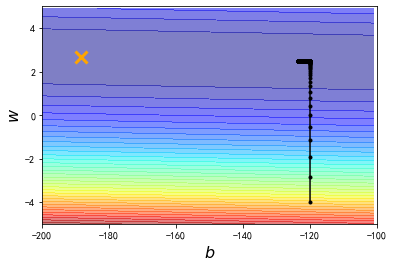
把learning rate增大10倍尝试
发现经过100000次的update以后,我们的参数相比之前与最终目标更接近了,但是这里有一个剧烈的震荡现象发生
xxxxxxxxxx# 上图中,gradient descent最终停止的地方里最优解还差很远,# 由于我们是规定了iteration次数的,因此原因应该是learning rate不够大,这里把它放大10倍# y_data = b + w * x_datab = -120 # initial bw = -4 # initial wlr = 0.000001 # learning rate 放大10倍iteration = 100000 # 这里直接规定了迭代次数,而不是一直运行到b_grad和w_grad都为0(事实证明这样做不太可行)# store initial values for plotting,我们想要最终把数据描绘在图上,因此存储过程数据b_history = [b]w_history = [w]# iterationsfor i in range(iteration): # get new b_grad and w_grad b_grad,w_grad=getGrad(b,w) # update b and w b -= lr * b_grad w -= lr * w_grad #store parameters for plotting b_history.append(b) w_history.append(w)# plot the figureplt.contourf(x,y,Z,50,alpha=0.5,cmap=plt.get_cmap('jet'))plt.plot([-188.4],[2.67],'x',ms=12,markeredgewidth=3,color='orange')plt.plot(b_history,w_history,'o-',ms=3,lw=1.5,color='black')plt.xlim(-200,-100)plt.ylim(-5,5)plt.xlabel(r'$b$',fontsize=16)plt.ylabel(r'$w$',fontsize=16)plt.show()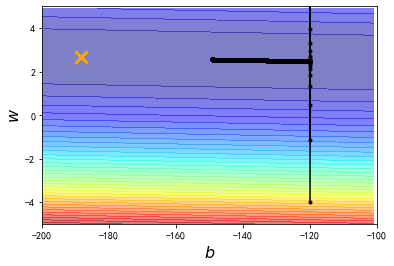
把learning rate再增大10倍
发现此时learning rate太大了,参数一update,就远远超出图中标注的范围了
所以我们会发现一个很严重的问题,如果learning rate变小一点,他距离最佳解还是会具有一段距离;但是如果learning rate放大,它就会直接超出范围了
xxxxxxxxxx# 上图中,gradient descent最终停止的地方里最优解还是有一点远,# 由于我们是规定了iteration次数的,因此原因应该是learning rate还是不够大,这里再把它放大10倍# y_data = b + w * x_datab = -120 # initial bw = -4 # initial wlr = 0.00001 # learning rate 放大10倍iteration = 100000 # 这里直接规定了迭代次数,而不是一直运行到b_grad和w_grad都为0(事实证明这样做不太可行)# store initial values for plotting,我们想要最终把数据描绘在图上,因此存储过程数据b_history = [b]w_history = [w]# iterationsfor i in range(iteration): # get new b_grad and w_grad b_grad,w_grad=getGrad(b,w) # update b and w b -= lr * b_grad w -= lr * w_grad #store parameters for plotting b_history.append(b) w_history.append(w)# plot the figureplt.contourf(x,y,Z,50,alpha=0.5,cmap=plt.get_cmap('jet'))plt.plot([-188.4],[2.67],'x',ms=12,markeredgewidth=3,color='orange')plt.plot(b_history,w_history,'o-',ms=3,lw=1.5,color='black')plt.xlim(-200,-100)plt.ylim(-5,5)plt.xlabel(r'$b$',fontsize=16)plt.ylabel(r'$w$',fontsize=16)plt.show()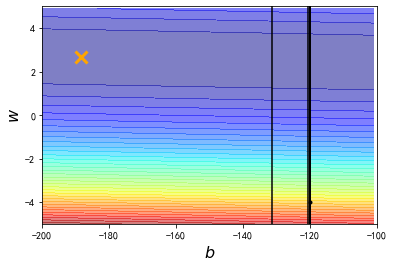
这个问题明明很简单,可是只有两个参数b和w,gradient descent搞半天都搞不定,那以后做neural network有数百万个参数的时候,要怎么办呢
这个就是一室不治何以国家为的概念
于是这里就要放大招了!!!——Adagrad
我们给b和w客制化的learning rate,让它们两个的learning rate不一样
xxxxxxxxxx# 这里给b和w不同的learning rate # y_data = b + w * x_datab = -120 # initial bw = -4 # initial wlr = 1 # learning rate 放大10倍iteration = 100000 # 这里直接规定了迭代次数,而不是一直运行到b_grad和w_grad都为0(事实证明这样做不太可行)# store initial values for plotting,我们想要最终把数据描绘在图上,因此存储过程数据b_history = [b]w_history = [w]lr_b = 0lr_w = 0# iterationsfor i in range(iteration): # get new b_grad and w_grad b_grad,w_grad=getGrad(b,w) # get the different learning rate for b and w lr_b = lr_b + b_grad ** 2 lr_w = lr_w + w_grad ** 2 # 这一招叫做adagrad,之后会详加解释 # update b and w with new learning rate b -= lr / np.sqrt(lr_b) * b_grad w -= lr / np.sqrt(lr_w) * w_grad #store parameters for plotting b_history.append(b) w_history.append(w) # output the b w b_grad w_grad # print("b: "+str(b)+"\t\t\t w: "+str(w)+"\n"+"b_grad: "+str(b_grad)+"\t\t w_grad: "+str(w_grad)+"\n") # output the final function and its errorprint("the function will be y_data="+str(b)+"+"+str(w)+"*x_data")error=0.0for i in range(10): print("error "+str(i)+" is: "+str(np.abs(y_data[i]-(b+w*x_data[i])))+" ") error+=np.abs(y_data[i]-(b+w*x_data[i]))average_error=error/10print("the average error is "+str(average_error))# plot the figureplt.contourf(x,y,Z,50,alpha=0.5,cmap=plt.get_cmap('jet'))plt.plot([-188.4],[2.67],'x',ms=12,markeredgewidth=3,color='orange')plt.plot(b_history,w_history,'o-',ms=3,lw=1.5,color='black')plt.xlim(-200,-100)plt.ylim(-5,5)plt.xlabel(r'$b$',fontsize=16)plt.ylabel(r'$w$',fontsize=16)plt.show()xxxxxxxxxxthe function will be y_data=-188.3668387495323+2.6692640713379903*x_dataerror 0 is: 73.84441736270833error 1 is: 67.4980970060185error 2 is: 68.15177664932844error 3 is: 28.8291759825683error 4 is: 13.113158627146447error 5 is: 148.63523696608252error 6 is: 96.43143001996799error 7 is: 94.21099446925288error 8 is: 140.84008808876973error 9 is: 161.7928115187101the average error is 89.33471866905532
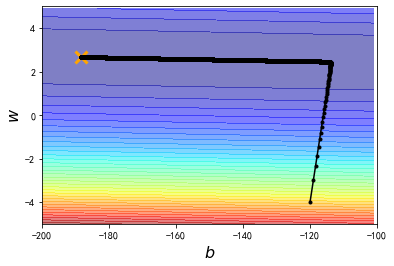
有了新的learning rate以后,从初始值到终点,我们在100000次iteration之内就可以顺利地完成了